

Narrated Essay: Deconstructing the Caterpillar
On imaginal cells and the winter gardener

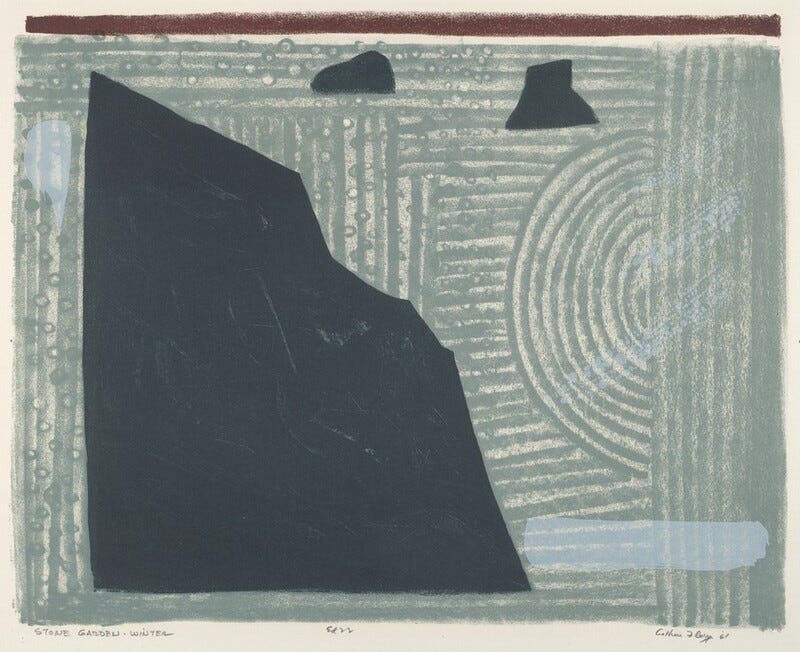
Just as there are darkened seasons in human history—times when the structures sustaining civilization collapse and humanity finds itself grasping at branches, falling between worlds—so too is every individual subject to phases of undoing in the metamorphosis of a lifetime.
Entering the chrysalis is rarely a matter of choice. We would resist if we could. We awaken with a pit in the stomach, a visceral unease that signals change, sometimes even before we can name its source. We realize we have entered a dream with no solid ground—and no turning back. Loss feels imminent and thick, along with the uncertainty of what comes next or how we will get there. We try to keep moving, flailing about, mistaking busyness for effectiveness. We hoist the blueprints of our former lives above our heads to keep them dry, attempting to shore up what is already dissolving—working very hard, as all creatures do, not to die.
We humans tend to see all this as failure. But for the caterpillar, entering the chrysalis is a devastation programmed for its survival and evolution. What can the larva comprehend of its fate as it surrenders to darkness and dissolution? Before it can be reconstituted, the caterpillar must pupate—which is to say liquify. Epithelial cells must break down, muscles and mandibles must be lysed by their own enzymes, and in this way, the caterpillar’s whole body must be reduced to a nutrient slurry.
Every winter, nature takes this serious turn. Fallen leaves coil in on themselves, roots retreat, seeds release, and death seems to wrap the living world. On the subject of what to do about it, here’s orientation from a recent column in our local magazine, the Santa Fe New Mexican —
“In winter, our arid steppe climate shows us the value of leaving things alone. Grasses left standing become shelter. Seed heads become sustenance. Evergreen shrubs offer cover from wind and predators when the world feels most exposed. What looks untidy to us is, in fact, a carefully balanced system of protection and patience. The garden does not ask us to fix it in January—only to witness it.”
The winter gardener knows not to fix depression, but instead to witness and accompany the world beyond our control. For the winter gardener recognizes the fallows as sanctuary, the outer casings of seed heads and pale grasses as fortresses of transformation, and death as a passage between birthing seasons. This is the winter gardener’s regenerative faith.
Similarly, but with respect to human development, renowned Jungian analyst and author Marion Woodman called the chrysalis “a twilight between past, present, and future,” a place where the psyche must “tolerate annihilation—just long enough for the new form to begin assembling itself.” She described the sojourn of life as a series of “border crossings between what we were and what we cannot yet imagine.”
For the caterpillar, the dream of the butterfly is carried by imaginal cells—tiny, sac-like clusters that, through the primordial twilight of metamorphosis, give rise to compound eyes, scaled wings, and an altogether more elegant anatomy. This is how a creature built for crawling holds within its body the potential for flight.
The most courageous way we can enter the chrysalis is with receptive attention. In his 1910 Oxford lecture, The Birth of Humility, anthropologist Robert Ranulph Marett described metamorphic thresholds as “psycho-physical,” when body and mind falter so that “latent energies [may] gather strength for activity on a fresh plane.” “Pause,” Marett wrote, “is the necessary condition of the development of all those higher purposes which make up the rational being.” Similarly, James Baldwin attested that the darkest hour can “force a reconciliation between oneself and all one’s pain and error.”
We cannot push ourselves through the chrysalis, for healing is an act of presence, not of power. But within the domain of consciousness, with forbearance, nurturance, and attention, we can rediscover the forces shaping our evolution and develop faith in what is not yet fully realized, but becoming.
In Jungian terms, the collective psyche mirrors the individual psyche: what collapses in the outer world—painfully, though necessarily—reflects what must be reimagined from within. We have entered an era of deconstruction, when democratic principles, values, and norms are unraveling before our eyes. Transformation is implicitly demanded, for, as Marett counseled, “Not until the days of this period of chrysalis life have been painfully accomplished can [a person] emerge a new and glorified creature.”
Now is the time to consider the imaginal intelligence within us that already knows the way. Even now, beneath the frost-hardened surface of days, something tender is organizing, cell by cell, into form. We may not yet recognize it, but we can keep watch, listen for its stirrings, and become stewards of what future is emerging. Soon will appear bare, arching green stems with winter jasmine, followed by white-cupped crocuses, blue-spiked grape hyacinth, and daffodils. And we will tell each other how, all along, the ground has been preparing for resurrection.
+ Join next month’s yoga & meditation class on Thursday, Mar 12, at 9 am MT / 11 am ET. A replay will be shared via email shortly thereafter.
+ Find me at YogaSource in Santa Fe every Wednesday morning, 9-10:15 am MT / 11 am-12:15 pm ET for Dynamic Practice. This class is fully analog—live and in person. Register through the studio here.
+ I’ll be returning to two beloved places to offer retreats with friends in the coming year: Beyul Retreat, in the pristine wilderness surrounding Aspen, Colorado, May 21-25, 2026, with Wendelin Scott; AND world-class Ballymaloe House in County Cork, Ireland, Sept 20-26, 2026, with Erin Doerwald. Each retreat will feature yoga, meditation, farm-to-table meals, and curated outings—plus rest, nurturance, and imagination. Just a few spots left. Check out all the details here.